
News in evidenza:

Bologna, varie sedi; Cesena
Nel mese di settembre 2026 tornano i classici appuntamenti con gli aperitivi scientifici e con i tour in città e dintorni.
Spettacoli, mostre, conferenze, per avvicinarci insieme alla Notte delle ricercatrici e dei ricercatori 2026.
L'evento festeggia il suo decimo anniversario portando la scienza tra i cittadini, con un focus speciale sui giovani.
La sezione INGV di Bologna partecipa al Programma Eventi

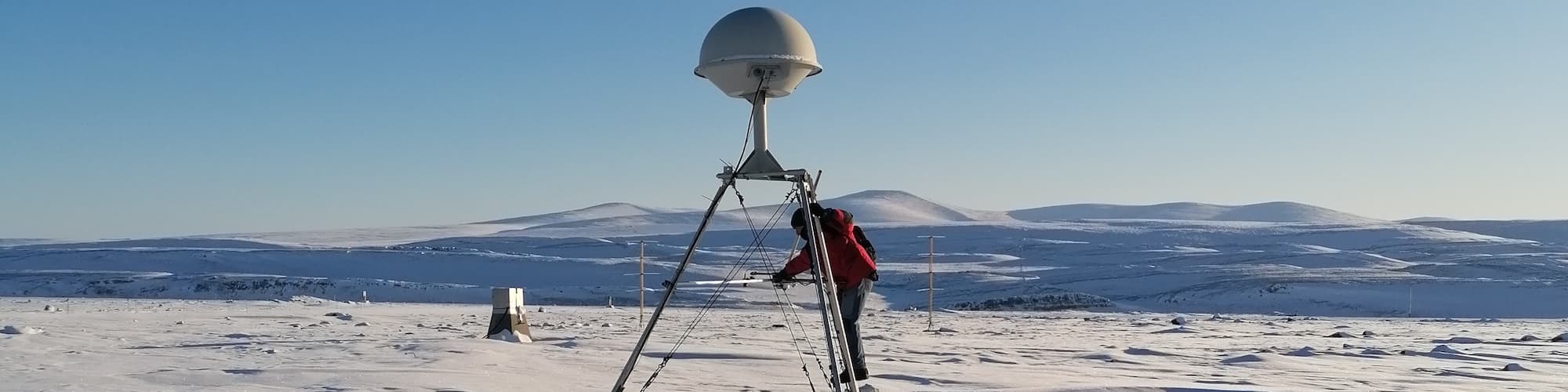
Pituffik, Wolstenholme Fjord, Groenlandia
Il 30 agosto ha preso il via la spedizione autunnale che vede impegnati 3 ricercatori e tecnici della Sezione INGV di Bologna, insieme a 4 colleghi della Sezione di Roma2 e di ENEA.
Saranno impegnati nelle attività di manutenzione e potenziamento degli osservatori THAAO
e HySO, quest'ultimo nato nel 2021 come attività del
progetto dipartimentale MACMAP.
La spedizione si svolge nell’ambito del progetto
iCEALP
,
con il co-finanziamento dell’INGV e del Centro Allerta Tsunami (CAT).
L’integrazione delle osservazioni sismiche, mareografiche e atmosferiche permette di rafforzare lo studio multidisciplinare dei processi che interessano il sistema atmosfera–ghiacciaio–fiordo–Terra solida, in una regione artica particolarmente sensibile agli effetti dei cambiamenti climatici.

Un podcast per parlare di Terra con le ricercatrici e i ricercatori della sezioneINGV di Bologna.
Si fa presto a dire Terra, ma come si studia un pianeta?
Come esploriamo la profondità del pianeta? Come è possibile decifrare le cause di fenomeni che sono tanto più grandi di noi, che sono spinti da forze che non vediamo ma sono in grado di sollevare le montagne, e di allargare gli oceani?
Ne parliamo in un podcast., le voci di ricercatrici e ricercatori ci racconteranno di esperimenti e di calcoli, di osservazioni e di analisi, di pericolosità e della sua percezione. Le voci di ricercatrici e ricercatori ci racconteranno di esperimenti e di calcoli, di osservazioni e di analisi, di pericolosità e della sua percezione
.
La sezione INGV di Bologna
Già sede INGV dal 2002, la Sezione di Bologna dell’Istituto Nazionale di Geofisica e Vulcanologia viene istituita nel 2005. Forte di un organico di circa 80 persone, la Sezione si distingue per l’ampia varietà dei temi di ricerca scientifica, che abbracciano i tre Dipartimenti dell’INGV: AMBIENTE, TERREMOTI e VULCANI.
I Servizi Amministrativi della Sezione sostengono la ricerca in tutti i suoi aspetti e contribuiscono alla gestione di attività e progetti.
La ricchezza di competenze e profili professionali stimola l’approccio interdisciplinare e favorisce lo sviluppo di ricerche su temi trasversali ai tre Dipartimenti. Ad esempio: la ricerca storica ricostruisce e cataloga eventi sismici, vulcanici o climatici del passato; e lo studio del cambiamento climatico, integra informazioni ricavate dalla sismicità di origine glaciale.
Ci dedichiamo volentieri alla comunicazione della scienza, organizzando eventi e proponendo percorsi didattici dedicati alle Scienze della Terra e alla mitigazione dei rischi naturali.
Partecipiamo a diversi gruppi operativi che intervengono sul territorio in emergenze sismiche o vulcaniche
La Sezione collabora con le Università e accoglie studenti per tirocini, tesi di laurea e dottorati
Alcuni articoli scientifici recenti:
Nel 1904, il professor Francesco Cavani, su incarico del Comune di Bologna, fu chiamato a valutare la stabilità della Torre Garisenda. A tal fine, sviluppò un innovativo sistema di monitoraggio, basato su un filo a piombo fissato a circa 40 metri di altezza sulla parete Sud e su cannocchiali specializzati, dotati di un doppio sistema di lenti e fuochi, in grado di rilevare spostamenti con una precisione fino a un ventesimo di millimetro. Le tavole allegate alla sua relazione presentano in dettaglio i dati di monitoraggio, comprensivi delle serie temporali degli spostamenti verso Est e Nord, rappresentate in scala ingrandita 20:1. In questo studio, le serie originali sono state digitalizzate, scalate ed esportate per essere analizzate con metodi moderni. L’obiettivo è quello di estrarre informazioni sulle caratteristiche dinamiche del movimento della torre, sia nel dominio del tempo che in quello delle frequenze. I risultati ottenuti mettono in evidenza le oscillazioni e le relative ampiezze, offrendo una lettura moderna e aggiornata del comportamento dinamico della struttura a oltre un secolo di distanza. Questo lavoro si propone come strumento per divulgare alcune informazioni di base sul comportamento della torre nel passato, al fine di valutare, in studi futuri, eventuali cambiamenti significativi nella caratterizzazione cinematica dei suoi movimenti. Inoltre si annunciano futuri sviluppi per aumentare la comprensione dei limiti spaziali e temporali dei risultati in considerazione delle imperfezioni dei grafici storici.
DOI

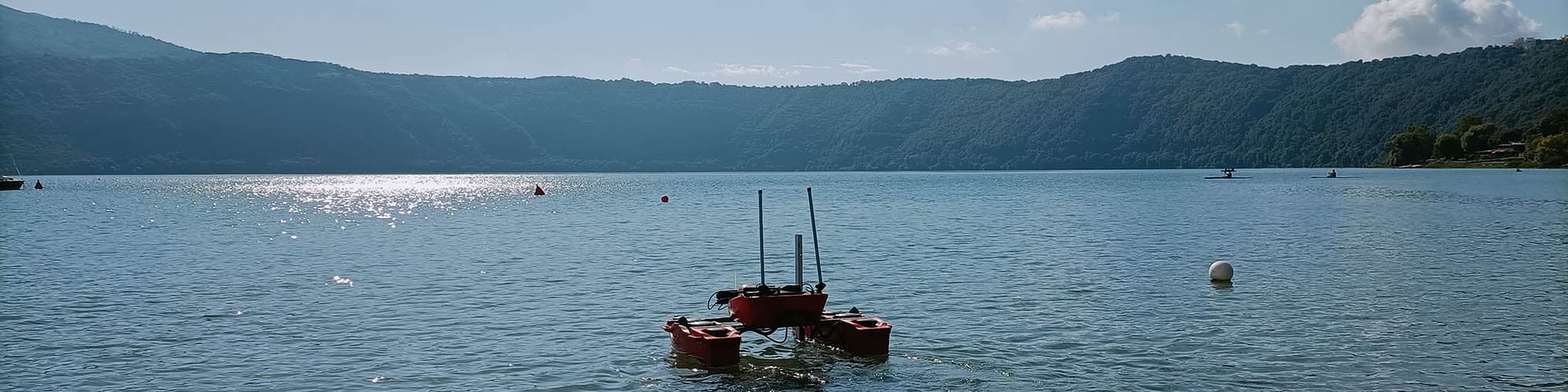
This study reports on the continuation of the 30-year surveillance of the CO2 content stored in Lago Albano for the most recent period from September 2020 to July 2023, in the aftermath of the last, minor seismic swarm in August 2020. We scrutinize whether the gradual decrease of the CO2 content (as dissolved CO2, HCO3−, and CO32−) in the lake waters through partial lake winter overturn events that followed the previous, major seismic events in 1989–1990 also occurred after the 2020 swarm, when approximately 450 ± 54 tons of total CO2 were injected into the bottom waters of Lago Albano. Despite this CO2 recharge and the consequent degassing of low magnitude, especially compared to the 1989–2019 period (154,000 ± 13,200 tons of CO2 recharge and steady yearly release), we found that the 2020 seismic swarm not only caused an increase in total CO2 content but also instigated a degassing above long-term background due to winter lake overturn. During the first post-seismic winter overturn (January 2021) up to 500 ± 60 tons of CO2 were estimated to have been released from the lake surface. As such, Lago Albano currently results less gas-rich than if the seismic swarm had not occurred. Nevertheless, climate change is expected to jeopardize winter overturn and, consequently, CO2 degassing as surface water temperature may not cool enough in the future; this will keep the lake permanently stratified (i.e., a higher degree of meromicticity) becoming a more efficient “gas storer”. Based on a total CO2 budget approach, this study highlights that dissolved CO2 is not necessarily fully degassed but it can be redistributed as HCO3−, CO32− and calcite, in addition to isotopic exchange between C-species and CH4 along the vertical profile of the lake, depending on pH-T conditions. Although this C-speciation can buffer the degassing capacity of Lago Albano, arguably lowering related gas hazards, it could primar- ily destabilize the biological activity (e.g., algal blooms) and its interaction with the changing atmosphere (i.e., more CO2-rich atmosphere) in the future.
DOI

Understanding the mechanisms controlling microseismicity in fluid-rich areas is key for assessing seismic hazards and the interaction between tectonics, magmatism, and geothermal systems. The Tuscan Magmatic Province, straddling the Tyrrhenian coast of southern Tuscany and northern Latium in Italy, is an ideal place to study these interactions. This region features high heat flow, extensive hydrothermal fluid circulation and several geothermal systems. However, the role of these fluids in controlling the microseismicity in the area is not fully understood. To shed light on this topic, we deployed a broadband seismic network that integrated the permanent regional networks from September 2020 to September 2021. Using state-of-the-art machine learning detection and probabilistic location methods, we detected and located 1,944 high-quality earthquakes with moment magnitudes ranging from Mw −0.2 to 2.8. By detecting approximately four times more events than reported by the regional catalogue, this new and high-resolution earthquake catalogue for the Southern Tuscany region (Italy) provides a more refined characterization of seismicity within Southern Tuscany’s unique geological framework. Our study reveals strong spatial clustering of seismicity along a NW-SE striking strip, parallel to the Apennines belt, and terminating in correspondence of the Monte Amiata geothermal system. West of this alignment, an additional cluster is associated with the Larderello-Travale geothermal system. Focal mechanisms indicate a coexistence of strike-slip and extensional style of deformation. A most prominent sequence consists of more than 500 events aligned along a NW-SE normal fault and exhibits clear upward hypocenter migration. The estimated velocities of the seismic front are in the order of 200-600 m/h. The calculated hydraulic diffusivities (10-15 m2/s) suggest fluid diffusion as the primary driver of the swarm. This is in agreement with the seismic sequences departing from magmatic bodies. To explain the source of the seismic swarm we propose a valve-type mechanism in which an initial tectonic failure phase progressively opens the fault system, enabling fluid advection that sustains subsequent seismic activity. The spatial correlation between seismicity and low-velocity crustal zones further supports the role of deep fluid circulation. These results show that microseismicity around geothermal systems in Southern Tuscany is shaped by the combined effect of tectonic stress loading and transient fluid overpressure, with implications for seismic hazard assessment and geothermal resource management.
DOI

This paper investigates the evolution of the La Fossa crater and Baia di Levante system at Vulcano Island between 2018 and 2024, focusing on the period following the 2021 unrest. Using a multiparametric dataset of ground and remote observations, we tracked the extent and intensity of volcanic degassing as it migrated from a primary and deeply sourced (La Fossa crater) to a peripheral and more hydrothermal zone (Baia di Levante, a bay at the base of the volcano). Our spatiotemporal analysis identified five distinct periods, each marked by specific physicochemical changes in the two areas. We observed a variable delay between the peaking of degassing in the central area and the arrival of gas in the peripheral zone, spanning from 7 months to nearly synchronous timing. Specifically, we suggest that the intense influx of deep fluids in mid-September 2021 transformed the complex network of fractures and shallow geothermal aquifers beneath Baia di Levante, significantly reducing its buffering capacity. This altered state persisted until the end of 2024, when a new deep fluid input observed at La Fossa crater was followed by an increased delay in degassing at Baia di Levante. We explain this variable delay through mechanisms such as fluid drainage and/or hydrothermal sealing of the more peripheral areas. This study underscores the critical importance of continuous monitoring of a volcano's fluid discharge capacity, particularly in identifying areas, where reduced degassing could lead to the hazardous accumulation of gas overpressure, as highlighted by the case of Vulcano Island.
DOI

This study focuses on the geochemistry of Rare Earth Elements (REE) and Li in the hyperalkaline soda brine of the remnant Rincón de Parangueo (RDP) maar lake, Mexico, a system characterized by the ongoing precipitation of trona, thermonatrite, halite and sylvite. Total REE concentrations in water range between 13.5 and 26.9 μg kg−1, while higher concentrations (688-1302 μg kg−1) were found in the associated bulk mineral precipitates (trona, thermonatrite, halite and sylvite). Lithium concentrations are higher than REE concentrations, in both RDP waters and bulk minerals. Lithium concentrations in RDP waters and bulk minerals precipitated are quite similar, ranging from 53.8 to 126.5 mg kg−1 and from 51.3 to 149.1 mg kg−1, respectively. Post Archean Australian shale (PAAS) normalized REE patterns in the waters increase from La to Lu. In contrast, PAAS normalized REE patterns of the bulk minerals are different from those of waters, also increasing from La to Lu but with a less pronounced trend. The distribution coefficient (KD) of REE and Li were calculated between the bulk precipitated minerals and the coexisting lake water. KD values of REE decrease from La to Lu and are significantly higher (6-1154), compared to KD values of Li (0.5-0.8). The REE patterns in waters, which increase from La to Lu, can be explained by the KD values, indicating preferential removal of LREE relative to HREE during mineral precipitation. Similar lithium concentration ranges in waters and bulk minerals are consistent with the low KD of Li, indicating a limited removal of Li from the solution during mineral precipitation.
DOI

Although fault-based approaches to seismic hazard assessment have been increasingly adopted worldwide, the official Italian hazard model, on which the national building code is based, still relies on a catalogue-based framework, with well-known limitations in capturing the long-term recurrences of large-magnitude events. In this study, we present a fault-based application to model seismicity rates for the southern Apennines (Italy) that incorporates a multi-fault rupture assumption. This area is of particular interest due to its active seismicity and the presence of large dams, for which robust long-term hazard estimates are essential. We use the SHERIFS code to model seismicity rates at the fault system-level, which allow us to explore epistemic uncertainties of fault and seismicity parameters (rupture scenarios, scaling laws, b-values and background seismicity). Our results highlight the key role of rupture models: scenarios allowing multi-fault ruptures outperform single-fault rupture models in terms of agreement with the regional seismicity and paleoseismic rates. Our findings support the inclusion of multi-fault rupture models in PSHA logic trees for the region and emphasize the need for improved fault behaviour characterization in southern Italy.
DOI

The transition from oceanic subduction to continental collision and, eventually, to delamination is thought to control dynamics, magmatism/metamorphism, and tectonic/sedimentation style in orogens. We propose for the first time that the alternation of slow and fast orogenic wedge advance and backarc opening in the retreating Apennines subduction zone (central Mediterranean area) was controlled by the transition from oceanic subduction to soft-collision (subduction of hyperextended continental lithosphere), evolving to hard-collision (subduction of the necking domain), and eventually to delamination. The coupling between slab dynamics and the evolution of the orogen is revealed by an unprecedented joint analysis of magmatism/metamorphism, of timing and rate of migration of forebulging, thrusting, and backarc extension and of seismic heterogeneities in the slab. Oceanic subduction and soft-continental collision, testified by high pressure-low temperature metamorphism, was characterized by fast orogenic and backarc extension migration, fast rotation of Corsica and Sardinia and vigorous magmatism. Low shear velocity anomalies observed in along-dip tomographic profiles across the Apennines are interpreted as signatures of slab damage events associated with the diachronous (at 21 Ma in the Northern and at 18 Ma in the Central/Southern Apennines) underthrusting of the necking domain of Adria in the Northern and Central-Southern Apennines. This hard-collision stage was characterized by slow orogenic wedge advance and backarc opening. The heating and weakening of the subducting continental crust produced by hard-collision promoted the transition from continental subduction to delamination of the Adria lithosphere. This process occurred at ca. 9 Ma and led to a relocalization of the subduction interface from the base of the sedimentary cover into the ductile middle crust and was associated with a renewal of fast orogenic wedge advance and backarc opening.
DOI
The 1976–1977 phreatic eruption of La Soufrière de Guadeloupe provides a natural laboratory to investigate how hydrothermal alteration and lithological variability influence eruption mechanisms in dome-hosted systems. These processes control rock fragmentation thresholds and the transition from pressurisation to explosive failure. We integrate petrophysical data, mineralogical analyses, and decompression experiments to estimate how alteration modulates fragmentation behaviour and energy partitioning. Representative lithologies were sampled from in situ dome rocks and 30 August 1976 breccia deposits to capture variability within the shallow hydrothermal system disrupted during the eruption, as well as basal dome analogues from Col de l’Échelle. Dry decompression experiments show thresholds from <5 MPa in porous, leached units to >30 MPa in dense, silicified andesites, demonstrating strong control of permeability (~10-18–10-12 m2), alteration style, and porosity (~1–54%) on dynamic strength. Steam-flashing experiments reveal lithological controls on energy partitioning: unaltered and silicified dome rocks require a median ~41% of available energy for fragmentation with limited particle acceleration, whereas altered, porous units require only ~9% and convert up to ~24% into kinetic energy, promoting comminution and acceleration. Experimental results and literature define a process-based framework for August lateral blast and summit explosions: unaltered dome rocks formed a strong carapace, while alteration created heterogeneous domains ranging from weak, porous lithologies in the summit and shallow dome to sealed, high-strength rocks within fault-controlled zones. Hot fluid influx likely pressurised fractures along the Ty fault, with rupture propagating through the dome; contrasts between carapace, altered rocks and sealed fractures likely governed rupture initiation and energy distribution once eruption began. Summit explosions were likely driven by destabilisation of the summit aquifer following flank eruption-related decompression, where steam-flashing efficiently fragmented weak, altered near-surface materials and generated ash-rich plumes. This study demonstrates that lithology-dependent thresholds and energy metrics can be used to quantitatively estimate phreatic eruption energetics and refine hazard assessment at hydrothermally active dome volcanoes.
DOI

Understanding why some fault systems produce seismic swarms while others evolve into foreshock–mainshock– aftershock sequences remains a central challenge in seismology. Fluids are known to play a key role, but numerical models are still far from reproducing the full complexity of solid–fluid interactions and the entire range of fault slip behavior. Here, we use a fully coupled 2D poro-visco-elasto-plastic fault model with rate-and-state friction to explore how pore-fluid pressure and permeability structure jointly shape fault slip behavior. The model resolves off-fault poroelastic deformation and fluid flow, and incorporates a slip- and time-dependent permeability evolution law. By systematically varying the along-strike widths of low-permeability barriers and over-pressurized patches relative to the nucleation size, as well as the healing timescale of permeability, we map out a continuum of dynamic regimes — from distributed, similar-sized clustering to system-size ruptures. Low-permeability barriers act as seismic asperities that promote rupture, whereas high pore-fluid pressure patches favor aseismic slip that redistributes stress. Following seismic ruptures that damage and unseal the fault zone, long permeability-healing times allow the resulting high-permeability pathways to remain open over multiple events, enhancing fluid redistribution and favoring swarm-like activity. In contrast, short healing times rapidly reseal these damaged pathways after each event, trapping fluids between barriers, amplifying stress concentrations, and promoting large, system-size dynamic ruptures. These results show how evolving fault-zone hydromechanics can generate diverse seismic sequences from common underlying physics, providing a framework for interpreting the natural variability in fault slip modes

Owing to the low N-S convergence rates between Adria and Europe, crustal deformation rates in the Alps and its forelands are low. Active tectonics are, therefore, difficult to study, especially as non-tectonic landscape forming processes can erase or modify the tectonic surface imprint. Large-scale and dense seismological data recently offered insights into earthquakes and into the lithospheric structure beneath the Alps. Recent field studies added data on geological archives of active tectonics. In this review, we summarize the results from studies of seismic tomography, geodesy, seismology, historical seismology, archeoseismology, on-fault and off-fault paleoseismology, and fault gouge dating, focusing on the eastern part of the Alps during the last c. 1 Ma. We discuss the influence of the lithosphere on the localization of deformation, and we draw a generalized picture of active deformation. We show that deformation is primarily accommodated across the South Alpine Front (∼2 mm/yr out of max 3 mm/yr total shortening) and NW-SE striking strike-slip faults in western Slovenia (∼1.5 mm/yr shear). Large fault systems in the interior of the Eastern Alps are still actively accommodating extrusion of crustal material toward the east at very low rates (0.5–1.0 mm/yr). Diffuse deformation and clusters of seismicity are observed in the interior of the Alps. Minor shortening occurs at the North Alpine Front. Crustal strength controls the localization of deformation resulting in non-deforming blocks. Neogene slab break-off events do not control the present-day deformation. Instead, present-day uplift of 1.5–2 mm/yr correlates to areas glaciated during the Last Glacial Maximum.
DOI

The tie vectors at co-location sites are required for combining the individual space geodetic solutions and computing the International Terrestrial Reference Frame. Their provision to the combination centres entails a proper and accurate alignment of the tie vector into the global geocentric frame. In order to assess the impact of different alignment strategies on the space geodetic combination, we test four alignment approaches—two similarity transformations and two transformations based on the local values of the deflection of the vertical—and focus on the residuals of the combination. Our results clearly show that the alignment strategy not only controls the orientation on the tie vector in the global frame—determining its global coordinates and components—but also impacts the magnitude of the tie vector’s combination residuals to an extent that can exceed the 1 cm level. In practice, the information carried by the same tie vector is affected by the alignment strategy—a step in the tie vectors’ production that we prove is critical and that can impact the combination of space geodetic techniques. At both sites, the alignment strategy (local topocentric to the global geocentric ITRF frame) that ensures higher consistency (i.e. smaller residuals) in the computation is the similarity transformation that makes use of all the available space geodetic reference points and no information about the DoV.
DOI

In a recent work, we tested the ability to compute earthquake parameters (location and magnitude) using citizen testimonies collected by the European-Mediterranean Seismological Centre (EMSC). Each intensity estimated by individual non-professional users of the LastQuake smartphone application is indicated as an individual data point (IDP). Each IDP is archived by EMSC with a time stamp, allowing the calculation of the time delay from the earthquake origin time. To use IDPs as classic intensities, i.e. macroseismic data points (MDPs), identifying damage at the scale of towns or cities, they must be grouped into spatial clusters, which are then processed by the BOXER code to locate and size global earthquakes. A retrospective analysis on a dataset of more than 15,000 events collected over the past 10 years shows that the procedure can provide reliable parameters and that the results depend on the geographical area and improve over time and as the number of available IDPs/MDPs increases. The key question is whether early IDPs/MDPs can quickly provide reliable parameters (location and magnitude) for users and stakeholders (e.g. the civil protection agencies). Using clustering methods that statistically provide, on average, the best agreement with instrumental data, we tested some predefined time intervals within which to group the available IDPs into MDPs. We then applied the BOXER code to these MDPs, evaluating the agreement with the final instrumental parameters. Results confirm that reliability increases with the number and distribution of MDPs, strictly dependent on the number and distribution of available IDPs. This retrospective analysis demonstrates the effectiveness of the approach and its potential to quickly provide parameters for future real-time applications. The method may offer a reliable and rapid tool to support emergency response, improving as more IDPs/MDPs are collected.
DOI

Managing induced seismicity risk is needed to enable the widespread adoption of geothermal technologies, facilitating the transition towards a decarbonized energy sector. In April 2022, real-time monitoring and forecasting of induced seismicity were tested during a three-stage hydraulic stimulation in a deep granite heat reservoir at the Utah FORGE site. Here, we analyze the recorded seismicity through statistical inference, and investigate the possible fracturing mechanisms triggered by the injection operation. Our analysis indicates that seismicity is likely induced by opening of a tensile fracture. Through pseudo-prospective forecasting, we then replay the Stage 3 stimulation and related induced seismicity as if it were happening in real-time. We demonstrate that even if the physical processes are complex and likely difficult to disentangle using seismicity alone, physics-based seismicity rate forecasting models show promise for stable forecastability of seismicity induced during hydraulic stimulation. Our results pave the way for Advanced Traffic Light Protocols (ATLP) to become standard operational technology in the mitigation strategies of deep geothermal projects.
DOI