
Il dipartimento Vulcani della Sezione di Bologna dell’INGV applica un approccio multidisciplinare che è complementare alla ricerca e al monitoraggio sui vulcani a livello nazionale ed internazionale. La sinergia tra i vari Gruppi di Lavoro all’interno della Sezione di Bologna risulta in una ricerca innovativa, originale e creativa, messa al servizio del pubblico e il mondo della ricerca.
Le aree di ricerca sono raggruppate nelle seguenti tematiche:
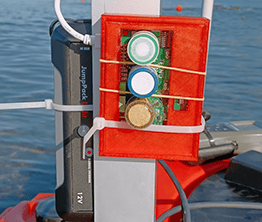
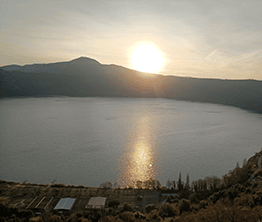
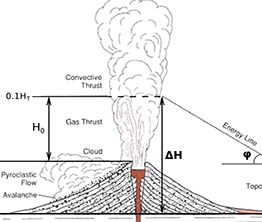
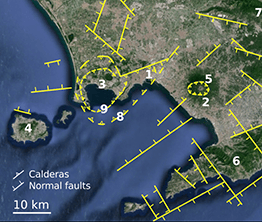
INSIGHT. Integrating geological data and Numerical SImulations for hiGH resolution assessment of volcanic ash dispersal in the Central Mediterranean: a Tool for understanding past impacts and raising preparedness
N/A
Dipartimento: Vulcani
Responsabile: Costa
N/A
Dipartimento: Vulcani
Responsabile: Costa
We combine values of column height HTP and mass eruption rate QM, radar derived, including the associated wind velocity (vW) for several eruptive events of Mt. Etna (Italy). Hence, we use a Monte Carlo Markov Chain approach to fit a parametric model relating HTP, QM and vW. The fitted model can then be used to quickly infer QM from observed HTP and vW. An outstanding feature is that HTP and QM are obtained from the same sensor reducing the overall uncertainty.
https://data.ingv.it/dataset/849#additional-metadata
https://data.ingv.it/dataset/849#additional-metadata
Volcanic gas ratios of the main fumarole of Nea Kameni volcano (March 2012-October 2014), acquired using a Multi-GAS of the DECADE network. Data are reported for the plume released by the summit open vent. All ratios are expressed on molar basis. Note that this file includes only processed data showing ratios of gases (calculated using the Ratiocalc software).
https://ecl.earthchem.org/view.php?id=1021
https://ecl.earthchem.org/view.php?id=1021
The MultiGAS was deployed on the crater’s rim on 4-7 December 2012 in order to measure the bulk plume composition of an air-diluted plume. A sustained steam plume was produced by the persistent fumarole field located ~200 m below the rim of its active central crater. SO2 gas fluxes have been obtained by deploying portable scanning DOAS (Differential Optical Absorption Spectroscopy) instruments (December 2012 and 2013).
https://ecl.earthchem.org/view.php?id=1020
https://ecl.earthchem.org/view.php?id=1020
On 28 November 2012, we used the MultiGAS (GPS-synchronized) to characterize the chemical structure and heterogeneity of Lastarria’s bottom fumarolic field. The plume was also measured in a fixed point for several hours on 29-30 November 2012. Note that this file includes only processed data showing ratios of gases (calculated using the Ratiocalc software). SO2 gas fluxes have been obtained by deploying portable scanning DOAS (Differential Optical Absorption Spectroscopy) instruments. All raw data is available in a separate file entitled "Volcanic gas plume data from Lastarria Volcano - Raw data" that can be downloaded from the same web location as this file.
https://ecl.earthchem.org/view.php?id=1019
https://ecl.earthchem.org/view.php?id=1019
Volcanic gas ratios in the plume of Villarrica Volcano November 2014-March 2015), acquired using a Multi-GAS of the DECADE network. Data are reported for the plume released by the summit open vent. All ratios are expressed on molar basis. Note that this file includes only processed data showing ratios of gases (calculated using the Ratiocalc software). All raw data is available in a separate file entitled "Volcanic gas plume data from Villarrica Volcano - Raw data" that can be downloaded from the same web location as this file
https://ecl.earthchem.org/view.php?id=1009
https://ecl.earthchem.org/view.php?id=1009
Volcanic gas ratios in the plume of Masaya Volcano (March 2014-January 2017), acquired using a permanent Multi-GAS of the DECADE network. All ratios are expressed on molar basis. Note that this file includes only processed data showing ratios of gases (calculated using the Ratiocalc software). All raw data is available in a separate file entitled "Volcanic gas plume data from Masaya Volcano - Raw data" that can be downloaded from the same web location as this file.
https://ecl.earthchem.org/view.php?id=1022
https://ecl.earthchem.org/view.php?id=1022